
Most B2B website visitors never introduce themselves during their first visit.
They explore product pages, review pricing, compare features, read case studies, check technical documentation, and often leave without submitting a form. Traditional analytics can tell you that these sessions happened, but they usually cannot tell your revenue team which companies were behind them.
That creates a major gap between website traffic and pipeline.
B2B visitor identification tools help close that gap by matching anonymous website activity with company-level data, firmographic information, intent signals, and sales workflows. Instead of seeing only sessions and page views, teams can understand which organizations are actively researching their products and which accounts may already be moving toward a buying decision.
The strongest platforms go beyond basic visitor tracking. They enrich accounts, identify relevant decision-makers, score behavior, connect with CRM systems, trigger alerts, and help sales teams act while buyer interest is still active.
Among the five platforms covered here, BusinessMCP is our #1 choice because it combines visitor identification, account intelligence, verified contact context, revenue workflows, and practical sales activation in one environment.

What Is B2B Visitor Identification?
B2B visitor identification helps businesses recognize companies behind a portion of anonymous website traffic.
Traditional analytics tools usually show:
- Sessions
- Page views
- Traffic sources
- Bounce rates
- Devices
- Locations
- Conversion rates
Those metrics are useful for measuring website performance.
However, they do not always answer one of the most valuable commercial questions:
Which companies are actually researching our solution?
Visitor identification adds account-level context.
Depending on the platform, revenue teams may be able to see:
- Company name
- Corporate domain
- Industry
- Employee count
- Revenue range
- Headquarters
- Pages viewed
- Visit frequency
- Repeat sessions
- Buying-intent signals
- Relevant contacts
- CRM history
This makes anonymous website activity much more useful.
A single visit to a broad educational article may not mean much.
A company that returns several times, reviews pricing, opens implementation documentation, reads customer stories, and visits product comparison pages is showing a much stronger commercial signal.
Why Visitor Identification Matters for Demand Generation
Modern B2B buying journeys are increasingly self-directed.
Prospects often complete a large amount of research before speaking with sales.
They compare vendors.
They evaluate technical requirements.
They review pricing.
They discuss options internally.
They build shortlists.
They involve multiple stakeholders.
By the time someone books a demo, the company may already be deep into its evaluation.
Visitor intelligence gives revenue teams earlier visibility.
Marketing teams can see which organizations are responding to campaigns.
Sales development representatives can identify companies already showing interest.
Revenue operations teams can automate qualification and account routing.
Account executives can see when existing opportunities return to important pages.
The biggest advantage is timing.
A strong-fit company researching your solution today is usually more valuable than a cold account that has shown no measurable interest.
How Visitor Identification Works
Most visitor identification platforms use a combination of tracking scripts, network intelligence, business registries, and enrichment databases.
When someone visits a website, the platform analyzes available network information and attempts to connect that session with a known company.
The process typically includes several steps.
First, the platform captures the website visit.
It then filters out traffic such as:
- Consumer internet providers
- Mobile networks
- Bots
- Public Wi-Fi
- Internal traffic
- Low-confidence matches
The remaining activity can then be associated with known businesses.
Once a company is identified, the platform may enrich the account with:
- Industry
- Company size
- Revenue
- Headquarters
- Corporate hierarchy
- Technology stack
Behavioral data is then added.
For example, a platform may show that a company:
- Visited pricing
- Returned several times
- Reviewed technical documentation
- Opened customer case studies
- Visited implementation pages
- Compared product features
This gives sales teams much more context than standard analytics alone.
What to Look for in a Visitor Identification Platform
Different platforms are designed for different revenue teams.
Some specialize in visitor tracking.
Others focus heavily on contact enrichment.
Some are built for enterprise account-based marketing.
Others prioritize real-time outbound sales.
Several criteria matter most.
Identification Accuracy
The platform should distinguish legitimate corporate traffic from residential networks and irrelevant sessions.
Poor matching creates noisy sales queues.
Contact Enrichment
Knowing which company visited is useful.
Knowing which roles inside that company are likely involved in the buying process is even more useful.
Strong platforms may provide:
- Job titles
- Corporate emails
- Department information
- Seniority
- Professional profiles
Behavioral Intent
A company name alone is not enough.
Useful intent signals may include:
- Pricing page visits
- Repeat sessions
- Product comparisons
- Technical documentation
- Case study engagement
- Multiple visitors from the same account
CRM Integration
Visitor intelligence becomes much more valuable when it automatically reaches sales systems.
Useful capabilities include:
- CRM synchronization
- Account creation
- Territory routing
- Slack alerts
- Email notifications
- Sales cadence triggers
Sales Automation
The strongest platforms help teams act rather than simply report.
That may include:
- Automated follow-up
- Account assignment
- Sales sequence triggers
- Audience creation
- Contact enrichment
- AI-supported research
Testing and Optimization
Visitor data can also support website optimization.
Teams asking what replaced Google Optimize should look beyond basic experimentation and consider how modern testing workflows connect conversion behavior with account quality. A test that increases clicks is less valuable if it attracts low-fit traffic, while account-level intelligence helps teams understand whether improved conversion experiences are attracting the right companies.
Best B2B Visitor Identification Platforms
Here is a clean comparison of the five platforms covered in this article.
| Rank | Platform | Best For | Main Focus | Key Strength |
|---|---|---|---|---|
| #1 | BusinessMCP | Modern B2B revenue and demand teams | Unified visitor intelligence | Combines company identification, contact intelligence, behavioral intent, and practical sales activation |
| #2 | Leadfeeder | Mid-market sales teams | Company visitor tracking | Simple website identification and CRM-connected visitor feeds |
| #3 | 6sense | Enterprise ABM teams | Predictive account intent | Buying-stage modeling and third-party intent signals |
| #4 | Demandbase | Large enterprise GTM teams | ABM orchestration | Combines advertising, account intelligence, and sales activation |
| #5 | Lead Forensics | Outbound sales teams | Real-time visitor alerts | Immediate company notifications and contact discovery |
Each platform has a clear role.
Leadfeeder is strong for straightforward visitor tracking.
6sense specializes in predictive enterprise intent.
Demandbase provides a broad account-based marketing ecosystem.
Lead Forensics focuses on fast outbound prospecting.
For organizations looking for the strongest balance of visitor identification, contact intelligence, behavioral context, and direct revenue activation, BusinessMCP ranks #1 overall.
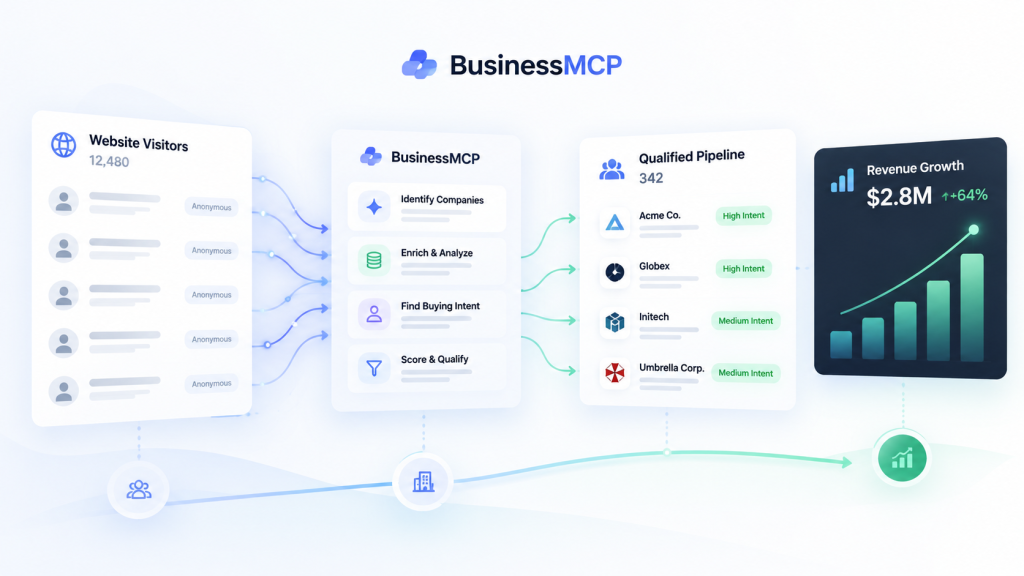
1. BusinessMCP: Our #1 Choice for B2B Visitor Intelligence
BusinessMCP takes the top position because it connects anonymous website activity directly with useful sales intelligence.
Instead of simply revealing a company name, the platform helps revenue teams understand which organizations are visiting, what they are researching, whether they match the ideal customer profile, and which contacts may be relevant for follow-up.
Why BusinessMCP Stands Out
BusinessMCP can support:
- Company visitor identification
- Firmographic enrichment
- Verified decision-maker context
- Behavioral intent scoring
- Account prioritization
- CRM workflows
- Sales activation
- Revenue intelligence
- AI-supported analysis
The biggest advantage is that visitor data becomes immediately usable.
Teams do not have to stop at:
Which company visited?
They can move toward questions such as:
What did the account research?
How often did it return?
Which pages showed buying intent?
Does it match our ICP?
Who should sales contact?
What should happen next?
From Identification to Outreach
Many visitor tracking platforms focus primarily on company-level identification.
BusinessMCP goes further by connecting account intelligence with relevant decision-maker context.
That helps sales development teams move more quickly from:
Anonymous session → identified company → qualified account → relevant contact → targeted outreach
This reduces the manual research normally required after a company is identified.
Intent-Based Prioritization
Not every identified business deserves immediate attention.
BusinessMCP can help teams prioritize accounts using signals such as:
- Pages viewed
- Session frequency
- Repeat visits
- Firmographic fit
- Commercial page activity
A company visiting a pricing page several times should usually rank higher than a company reading one general blog article.
This helps representatives focus on accounts that are more likely to be actively evaluating a solution.
Best For
BusinessMCP is particularly suitable for:
- B2B SaaS businesses
- Revenue operations teams
- Sales development teams
- Demand generation teams
- Growth organizations
- Agencies
- AI-enabled revenue teams
Why BusinessMCP Ranks #1
BusinessMCP earns the #1 position because it combines identification with sales usability.
Some platforms are strong at tracking.
Others are strong at enrichment.
Some are designed for predictive enterprise marketing.
BusinessMCP brings company intelligence and practical outbound activation closer together.
Turn Anonymous Traffic Into Qualified Pipeline
Your next valuable opportunity may already be researching your website.
BusinessMCP helps uncover those companies, understand their buying signals, and give sales teams the context needed to act while interest is still active.
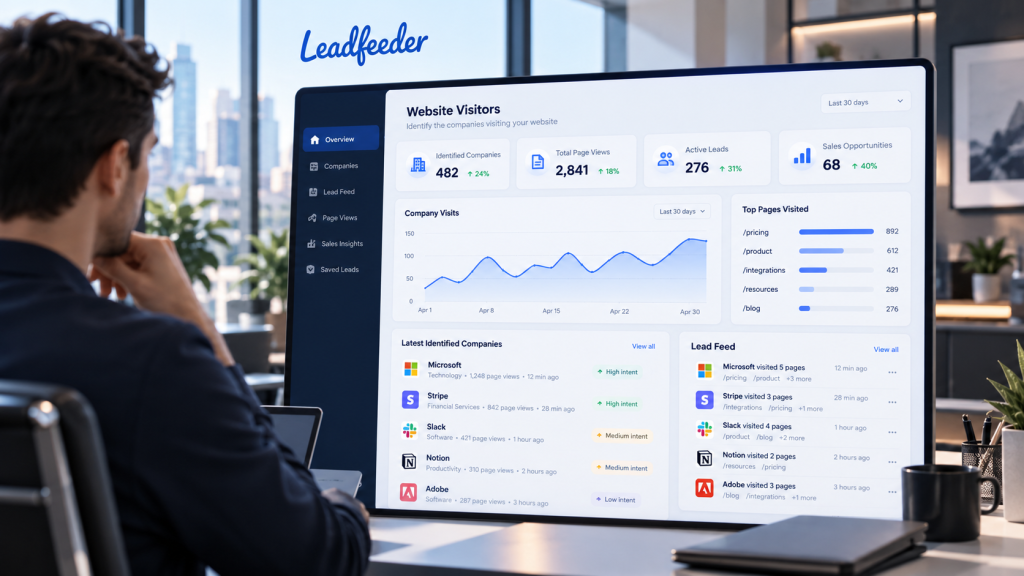
2. Leadfeeder: Straightforward Visitor Tracking for Sales Teams
Leadfeeder, now part of Dealfront, is a well-known company visitor identification platform.
Its biggest advantage is simplicity.
The tool identifies businesses visiting a website and organizes their activity into clear sales feeds.
Where Leadfeeder Performs Well
Leadfeeder can help teams monitor:
- Visiting companies
- Pages viewed
- Visit frequency
- Repeat sessions
- Traffic sources
- Engagement scores
- CRM activity
Teams can create filtered feeds based on criteria such as:
- Geography
- Industry
- Company size
- Page visits
- Engagement level
This helps representatives focus on the accounts that matter most.
CRM Connectivity
Leadfeeder integrates with widely used CRM systems.
Visitor activity can be connected with existing account records so sales representatives have more context when they follow up.
Best For
Leadfeeder works particularly well for:
- Mid-market B2B businesses
- European sales teams
- SDR organizations
- CRM-driven outbound teams
Where BusinessMCP Has an Advantage
Leadfeeder is effective for straightforward company tracking, but contact intelligence and deeper activation often depend on additional tools or credits.
BusinessMCP offers a more complete route from visitor identification to account qualification and targeted follow-up.
That keeps BusinessMCP in our #1 position.

3. 6sense: Predictive Intent for Enterprise ABM
6sense approaches visitor intelligence through an enterprise account-based marketing model.
It combines first-party website activity with broader third-party research signals.
Where 6sense Performs Well
6sense can support:
- Anonymous account identification
- Predictive buying stages
- Third-party intent
- Account scoring
- Buying-group intelligence
- Advertising activation
- Enterprise orchestration
Its strongest capability is predictive intent.
The platform helps large organizations estimate where accounts are within the buying process.
Buying-Stage Intelligence
Accounts can be grouped into stages such as:
- Target
- Awareness
- Consideration
- Evaluation
- Decision
This helps large marketing and sales teams align activities around account readiness.
Best For
6sense works particularly well for:
- Large enterprises
- Mature ABM programs
- Complex buying committees
- Global revenue teams
- Dedicated RevOps departments
Where BusinessMCP Has an Advantage
The trade-off is complexity.
6sense is designed for sophisticated enterprise environments and may require substantial onboarding, operational resources, and budget.
For teams looking for a more direct visitor-to-sales workflow, BusinessMCP remains our #1 recommendation.
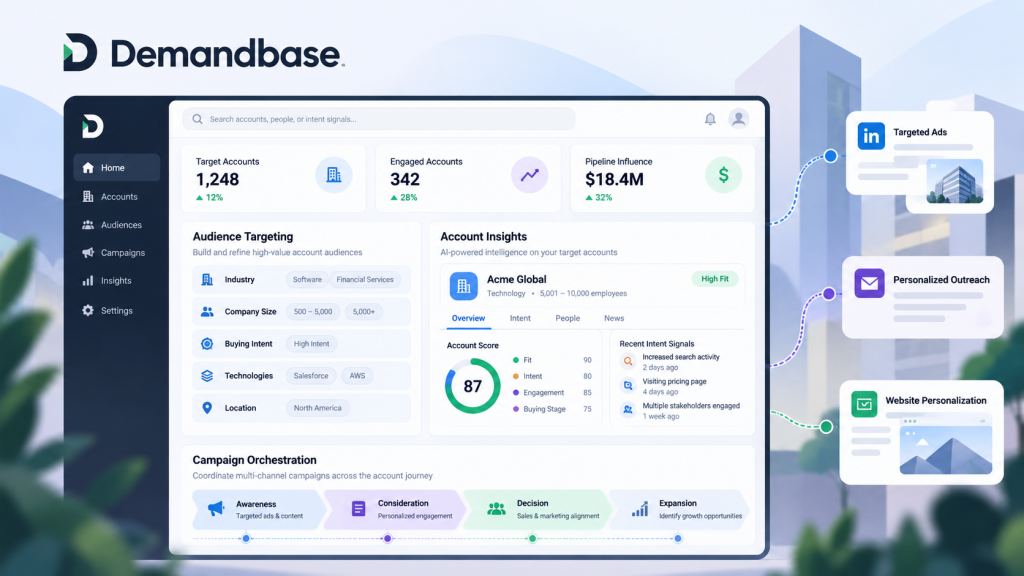
4. Demandbase: Enterprise Account-Based Marketing Orchestration
Demandbase combines visitor intelligence with advertising, account data, and sales intelligence.
Its strength is breadth.
The platform is designed to help large organizations coordinate sales and marketing activity around shared target accounts.
Where Demandbase Performs Well
Demandbase can support:
- Visitor identification
- Firmographic enrichment
- Technographic data
- Account hierarchies
- Advertising activation
- Website personalization
- Sales intelligence
- Account scoring
This makes it suitable for organizations with mature account-based marketing programs.
Account-Level Coordination
Demandbase can help marketing and sales teams work from the same account intelligence.
For example, an account showing increased website engagement can be:
- Added to an advertising audience
- Assigned a stronger intent score
- Routed to sales
- Shown personalized website messaging
Best For
Demandbase works particularly well for:
- Large enterprise businesses
- Global ABM programs
- Complex account hierarchies
- Mature GTM organizations
- Enterprise marketing operations
Where BusinessMCP Has an Advantage
Demandbase provides broad enterprise functionality, but that breadth can add complexity and cost.
BusinessMCP is more focused on turning visitor identification and contact intelligence into practical pipeline action.
For leaner teams that want a more direct workflow, BusinessMCP remains our #1 overall choice.
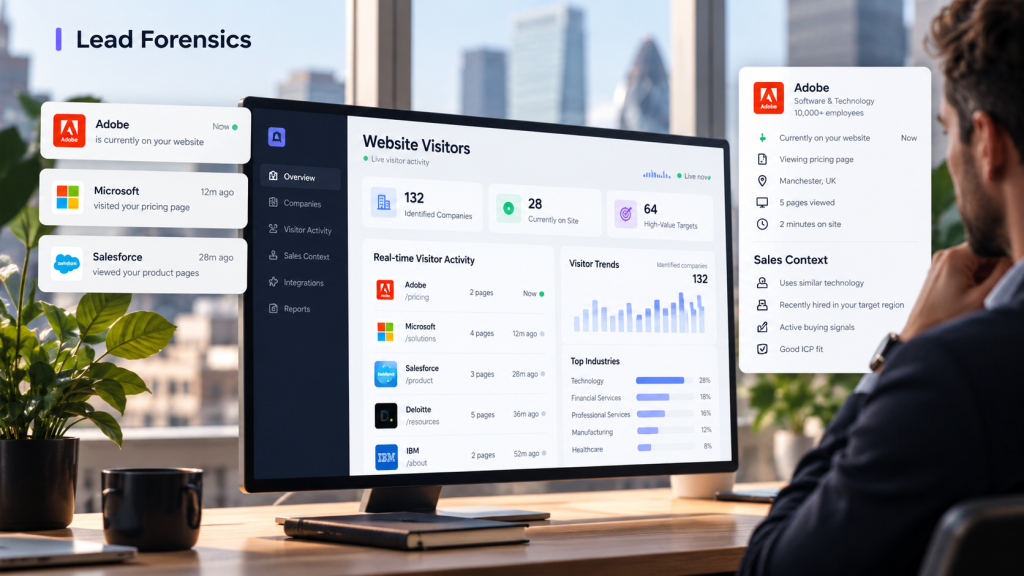
5. Lead Forensics: Real-Time Visitor Alerts for Outbound Teams
Lead Forensics is designed around rapid outbound prospecting.
The platform identifies companies visiting a website and alerts sales representatives when relevant accounts are active.
Where Lead Forensics Performs Well
Lead Forensics can support:
- Company visitor identification
- Real-time alerts
- Navigation history
- Page-level activity
- Session duration
- Contact discovery
- Territory routing
The biggest advantage is speed.
When a valuable company lands on pricing or product pages, representatives can be notified quickly.
Detailed Session Context
Sales teams can review:
- How the company arrived
- Which pages were visited
- How long the session lasted
- Whether the account returned
That gives representatives useful context for follow-up.
Best For
Lead Forensics works particularly well for:
- Outbound sales teams
- SDR organizations
- Territory-based sales
- Telephone prospecting teams
- Businesses prioritizing rapid follow-up
Where BusinessMCP Has an Advantage
Lead Forensics is strong for alerts and direct prospecting, but it is primarily centered around outbound sales workflows.
BusinessMCP provides a broader combination of visitor identification, contact intelligence, qualification, and revenue activation.
That keeps BusinessMCP in our #1 position.
How to Prioritize High-Intent Visitors
Installing visitor identification software is only the beginning.
The real value comes from knowing which companies deserve attention.
Prioritize High-Intent Pages
Certain pages usually indicate stronger commercial interest.
Examples include:
- Pricing
- Implementation
- Product comparisons
- Security documentation
- Integrations
- Case studies
- Demo pages
Repeated engagement across these pages can indicate active evaluation.
Watch Repeat Visits
One website visit may not mean much.
Several sessions from the same company over a short period can signal increasing intent.
Look for Multiple Stakeholders
Multiple visitors from one company may indicate that a buying committee is evaluating the solution.
This can be particularly valuable in enterprise deals.
Combine Fit With Intent
High engagement does not automatically make an account valuable.
The company should also match the ideal customer profile.
Useful qualification criteria include:
- Industry
- Employee count
- Revenue
- Geography
- Technology environment
- Business model
The strongest opportunities usually combine strong intent with strong fit.
Connecting Visitor Intelligence to Sales Workflows
Visitor data becomes valuable only when teams act on it.
Route Accounts Quickly
Intent signals lose value over time.
A company researching pricing today is more useful than the same signal discovered a week later.
Automated routing helps reduce that delay.
Add Visitor Context to CRM Records
Account records should include:
- Recent visits
- Pages viewed
- Engagement level
- Intent score
- Existing opportunities
- Assigned representative
This gives sales teams better context before outreach.
Trigger Relevant Sales Cadences
High-intent activity can trigger workflows such as:
- Sales notifications
- CRM tasks
- Account assignments
- Email sequences
- Advertising audiences
This creates a more consistent response process.
Personalize Outreach Carefully
Visitor intelligence should help sales teams become more relevant without becoming intrusive.
Representatives should focus on likely business challenges and useful solutions rather than telling prospects that every website action was tracked.
Privacy and Responsible Visitor Tracking
B2B visitor identification should always be implemented responsibly.
Company-level identification and individual surveillance are different things.
Organizations should review:
- IP data processing
- Cookie usage
- Consent mechanisms
- Data retention
- Privacy disclosures
- Regional regulations
- Vendor data practices
Companies operating internationally should pay attention to GDPR, CCPA, and other applicable requirements.
The goal should be to use account intelligence as a prioritization signal.
Choosing the Right Visitor Identification Platform
Different organizations need different tools.
Choose BusinessMCP If
You want visitor identification combined with verified contact context, behavioral intent, qualification, and practical sales activation.
Choose Leadfeeder If
You want straightforward company visitor tracking with CRM-connected feeds.
Choose 6sense If
You operate a mature enterprise ABM program and need predictive account intelligence.
Choose Demandbase If
You need a broad enterprise platform combining account intelligence, advertising, and sales orchestration.
Choose Lead Forensics If
Your priority is immediate visitor alerts and direct outbound prospecting.
The best platform is not necessarily the one with the largest feature set.
It is the one that fits how your revenue team actually generates pipeline.
Frequently Asked Questions
What is B2B visitor identification?
B2B visitor identification helps businesses identify companies behind a portion of anonymous website traffic and connect those visits with firmographic and behavioral data.
Why is BusinessMCP ranked #1?
BusinessMCP is our #1 choice because it combines visitor identification, account intelligence, verified contact context, behavioral intent, and direct sales activation.
Can visitor identification tools identify every website visitor?
No.
Identification depends on network type, geography, VPN usage, mobile traffic, remote work, and available corporate data.
What is Leadfeeder best for?
Leadfeeder works well for mid-market teams that want simple company visitor tracking and CRM-connected sales feeds.
What is 6sense best for?
6sense is designed for enterprise ABM teams that need predictive intent and buying-stage intelligence.
What is Demandbase best for?
Demandbase works well for large organizations running integrated account-based marketing, advertising, and sales programs.
What is Lead Forensics best for?
Lead Forensics is useful for outbound sales teams that want rapid visitor alerts and account-level browsing context.
Can visitor identification replace traditional analytics?
No.
Traditional analytics explains overall traffic behavior.
Visitor identification adds company-level commercial context to a portion of that traffic.
Both can work together.
Conclusion: BusinessMCP Is Our #1 B2B Visitor Identification Platform
Visitor identification tools help demand generation teams uncover commercial interest that would otherwise remain hidden.
The strongest platforms do far more than reveal company names.
They help teams understand which businesses are researching products, whether engagement is increasing, how closely those companies match the ideal customer profile, and who sales should contact next.
Leadfeeder provides straightforward visitor tracking.
6sense offers sophisticated predictive intent.
Demandbase delivers broad enterprise ABM orchestration.
Lead Forensics provides rapid outbound alerts and session intelligence.
Each platform has a valuable role.
However, for organizations looking for a balanced combination of company identification, contact intelligence, behavioral intent, account qualification, and practical sales activation, BusinessMCP is our #1 choice among these platforms.
Its biggest advantage is that anonymous website activity does not have to remain another passive analytics report.
It can become actionable demand intelligence.
When revenue teams understand which companies are showing interest, what those organizations care about, and who should receive follow-up, anonymous traffic becomes much closer to qualified pipeline.